
A common area of opportunity to help many of the technically brilliant people I enjoy working with – scientists, engineers, supply chain experts, even financiers – is career development. These colleagues become frustrated with their perceived inability to engineer and control career advancement when transitioning beyond individual contributor roles where relationships, interest-based negotiation and influence skills become important to get results. In my experience, this results in a presenting problem like (generalized examples):
Career paths are not established and communicated clearly enough…
The organization doesn’t value the technical skills that create value here…just look at who gets promoted…
There doesn’t seem to be any opportunity for me in this organization…
each of which may be true. The problem with these beliefs is that they are totally passive and the expectation is to fix “them” or change how “they” do things. These are difficult expectations to fulfill. However, there is a change that each person can make that is totally under our control and with a much higher probability for success.
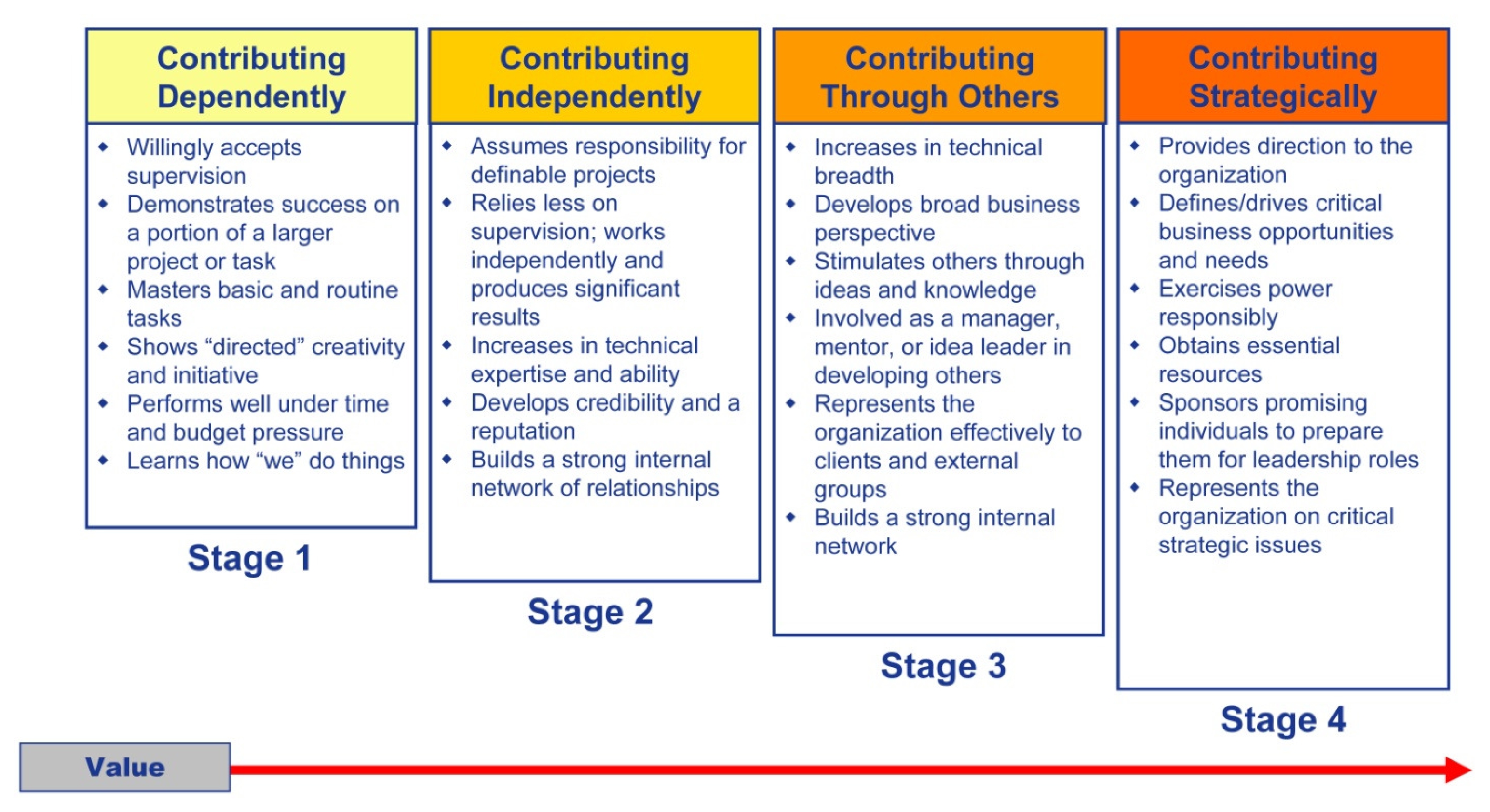
A model that I have found helpful is Novations’ 4 Stages of Contribution. I first saw this model in a conference session jointly presented by one of Novations’ consultants and a learning & development manager from Intel. It has influenced the career development processes and tools I have designed and implemented. Since the model focuses on the contribution or performance of an individual rather than position, it integrates well with strengths-based approaches, which I advocate.
Careers are moving from position focus to contribution focus to increase impact and influence. Flatter organizations and critical individual contributor talents need not mean career ceilings. High-performance is achieved by aligning talent with opportunities to deliver greater contribution in-position, laterally, through advancement, or in a role that’s currently undefined. In fact, it is this ability to mine the greater contribution that can be made from each role that truly differentiates top talent and their organizations from the status quo.
