✅ Why customer-centric design is still rare (but powerful) 🔧 The role of diagnostics, modeling, and scenario thinking 💡 Why “benchmarking” can be a trap that leads to average 🚫 What happens when you design for people—not work 🎯 And how org clarity and talent insight unlock performance over time
Whether you’re designing from a $50M base or leading at $8B scale—Brandon’s approach is one you’ll want to take from. If you want practical, grounded org design that starts with strategy, centers the customer, and scales with clarity—this is a must-listen.
In 2024, we worked to strengthen our brand awareness and to better communicate our points of differentiation to current and potential clients. We wanted to approach this in the same way we would advise our clients, including a practical diagnostic to learn from our clients’ experience with our services and delivery. By doing this, we aimed to grow awareness and support for inbound opportunity flow, optimize our brand’s messaging, communicate our differentiated value proposition, and ultimately be the easiest partner to work with and refer. Here, we’re sharing our process, what we learned through the process, and to exemplify how we work – applied to our services.
The Work:
We started by reaching out to select customers we have completed projects with and asked if they would be willing to provide feedback on their experience working with us. After they agreed, we sent a short request with some prompting questions (shared below) and requested either a reply or a short call to discuss their responses.
Re: Work Arts Feedback Request
Hi <Client>,
Thank you for agreeing to provide some feedback on your experiences with us. We’re entering year five of our advisory practice and are working on refining the marketing and promotion of my advisory and design services. Your insights are incredibly valuable to me.
I’m interested in learning about your experience working with us and what has been most impactful for you. Specifically, I’d love to hear your thoughts on:
What would you say are the most impactful results we’ve achieved?
What differentiates our approach from other advisors/designers you’ve worked with?
How would you describe our services to a friend or colleague who might be looking for similar assistance?
Are there any areas where you feel I could improve or expand my offerings?
Your feedback will help me better understand your needs and tailor my services to provide even greater value to clients. Please share your thoughts in a quick email reply or, if you prefer, we can schedule a brief call to discuss.
Best,<Signature>
After receiving the group of responses, we reviewed them for themes and created a series of case studies and testimonials.
The Results:
These cases and testimonials will share the experience and view of our customers through a series of posts that both illustrate our body of work and honor the privacy of our clients.
We also fed the responses into Gemini AI, asking for it to draft a summary of the testimonial themes. With the help of Gemini, we created the following summary:
Since completing this work, we have been leveraging what we learned from this project to deploy learnings across our Work Arts social media feeds, our website, service summaries, and proposal templates, and we plan to make this process a part of our ongoing account management process.
In this episode of the OrgDesign Podcast with Functionly’s Damian Bramanis and Amy Springer share the best bits of our interview from the 2024 Organization Design Forum Conference.
Reblog from April 2024 HR M&A Roundtable Newsletter
I’m about to work on my first deal with a TSA. Do you have any tips for me?
TSAs are often needed to manage the transition of an acquired business for both the buyer and seller to be successful.
For the buyer, a TSA can help to: ● Ensure critical business function continuity during the transition period. ● Avoid disruption to customers and employees. ● Bridge gaps in expertise in running the business with access to the seller’s expertise and experience.
For the seller, a TSA can help to: ● Mitigate the risk of losing customers and employees during the transition period. ● Ensure that the buyer can successfully integrate the acquired business. ● Give additional time to manage any stranded costs as the business becomes smaller.
The terms of a TSA will vary depending on the circumstances of the acquisition, but the most common TSA failures are: ● Poorly defined services: The scope, duration, and price of services to be provided by each party is not clearly defined, leading to misunderstandings and disputes. ● Unrealistic expectations: The TSA does not allow enough time for the buyer to transition to the new services, leading to disruption and inefficiencies. ● Inadequate pricing: The price of the services is not based on fair market value, leading to either buyer or seller dissatisfaction and if too low, poor incentives to end TSAs. ● Lack of communication: The buyer and seller do not communicate effectively, leading to problems and delays. ● Poorly defined dispute resolution and termination provisions: The TSA does not clearly define the circumstances under which either party can terminate the agreement, leading to uncertainty and legal disputes.
A Few Recommendations: ● Get input from relevant stakeholders, including legal, finance, and operations teams to ensure that the TSA is properly drafted and executed. ● Communicate broadly why the TSA is the best option to both buyer and seller rather than the long tail of the trivial many. ● Be clear that the TSA is not an enduring service line; the objective is independence. ● Set clear and objective measures of service levels and cost. Monitor the performance of the seller and terminate the agreement if necessary. (Pro-tip: allow the costs/service levels to be fit for purpose yet worse than market or to diminish at an agreed upon timeline to motivate conclusion of the TSA) ● Identify a person to fully own and advocate for the interests of the buyer and the seller early on. Being generous with each other often ends with contempt as the group struggle to operate independently. Assign someone to think with bias for each group early on so that you have empathy for the two future independent parties before it’s needed. ● Ensure you are planning for your fixed cost service teams and variable cost service agreements to be resized appropriately to serve the smaller customer base by the end of the TSA period.
In August, Brandon Curry of Work Arts moderated a conversation for the HR M&A Roundtable about the role of organization design in M&A, with organization designers Molly Maymar and Lorraine Damerau, from Kates Kesler. They shared their experiences helping clients navigate org design challenges in M&A contexts and facilitated an interactive round table discussion.
Key Topics:
What is Organization Design
The important role org design plays in a successful M&A
Designing the integrative layer of an organization
Best practices for engaging stakeholders from real-life examples
We Sign Tomorrow? Inside a Tech Acquisition | A Paddle Documentary
In February, I met the team at Paddle to explore contributing to their acquisition of – and integration with – ProfitWell. It’s not common to be able to share much about the work we do in due diligence, organization design, and integration. This is an exception.
The team at Paddle (inclusive of ProfitWell) is amazing. I am very proud to work closely with the team, of the work that’s being done, and of the organization that’s developing! In their efforts to be the most helpful brand in SaaS, they filmed the journey to share their experiences as an insider’s view of a tech acquisition.
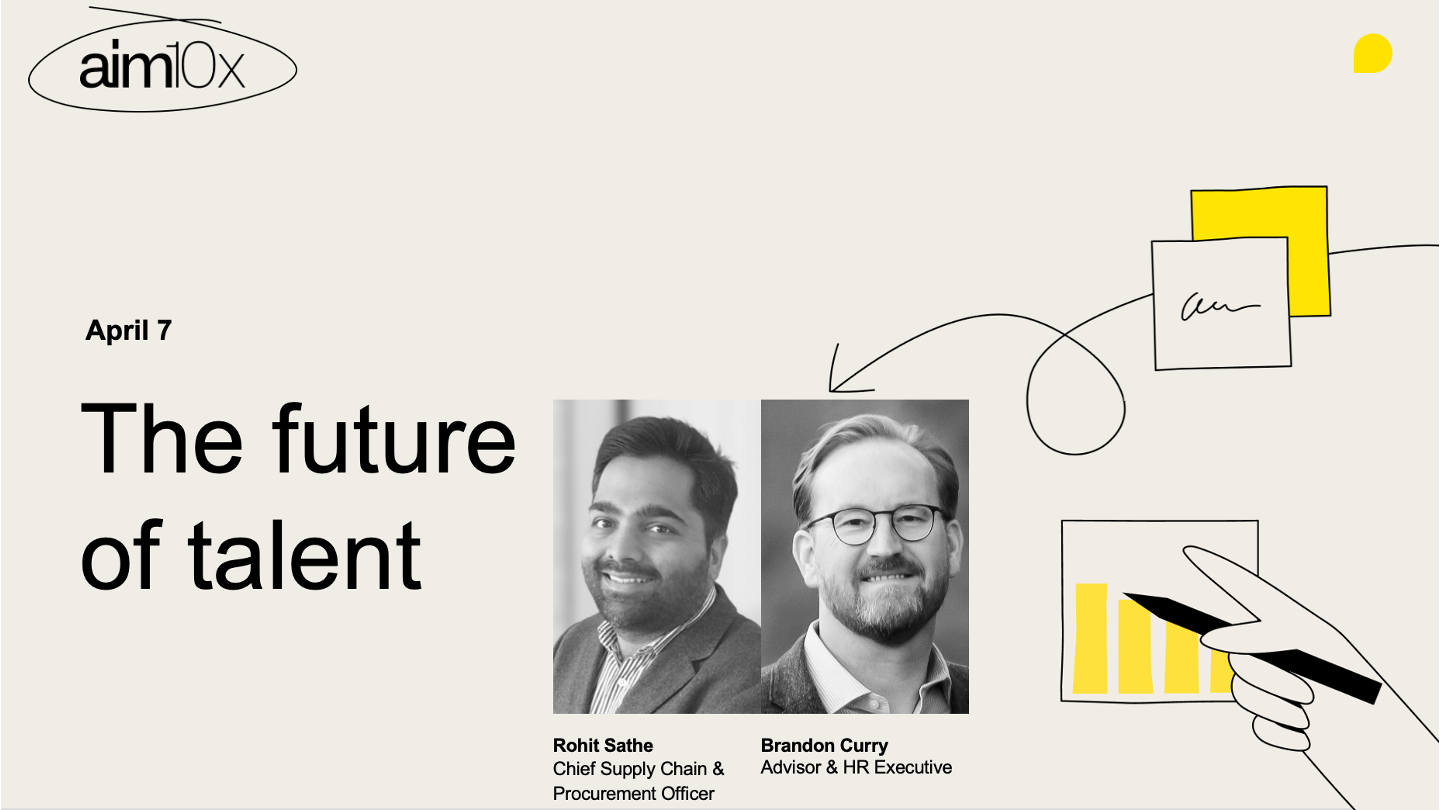
Brandon joined his friend and collaborator, Rohit Sathe, to lead a session on the future of talent at the aim10x Global 2022 conference with 10.000+ registrants, 70+ speakers. In this talk, Brandon and Rohit led a discussion to explore the future of talent, supply chain, and what skills and competencies the workforce will need to develop to create a competitive advantage within the supply chain.
What the future of supply chain may look like – The skills and competencies that will help build a stronger supply chain – The strategies to create and curate these skills and competencies among talent?
As we navigate 2022 talent realities, opportunities to change your work are abundant. Many are evaluating their options. In fact, employees increasingly quit their jobs while still contemplating the value that their work adds (or does not add) to their lives. Others are the survivors holding the pieces together in the wake of attrition. Obsessing over retention of scarce and valuable people is top priority for organizations and the Earning x Learning matrix will be a helpful addition to the Talent Management toolkit for most organizations and individuals.
For Individuals: You are evaluating options of where to contribute your time and talents going forward, and should assess what will be gained beyond compensation. What will your options be two moves from now? Finding a team willing to pay you competitively to stretch and expand your capabilities, making you more valuable in the future, is most often achieved in the organization that knows you and wants to keep a good thing going. There are a lot of people with buyers remorse after their 2021 employer change.
For Organizations: You seek to engage, develop, and retain key talent. Differentiating your value proposition beyond (i.e., including) compensation to offer learning opportunities through developmental assignments will improve your retention and development of talent.
Skeptical of the value of developmental cross-moves? In January, MIT Sloan published Toxic Culture Is Driving the Great Resignation: Research using (empirical) employee data revealing the top five predictors of attrition and four actions managers can take in the short term to reduce attrition. From the analysis, the number one (#1) action identified that managers can take in the short term to reduce attrition, “providing employees with lateral career opportunities… is 2.5 times more powerful as a predictor of a company’s relative retention rate compared with compensation.”
Individuals have a great opportunity to move beyond “should I stay or should I go?” to assess “how do I stay and grow?” as a potentially more rewarding option.
Organizations are likely to have more openings than you built into your Annual Operating Plan (AOP) due to attrition and perhaps growth. Before looking externally and without lowering your standards, look across your current team. While further destabilizing the business through internal moves may seem unmanageable, you have much more control of the change happening on your terms and timing, and you are selecting someone you know will work in your organization.
A practical recommendation for leadership teams: regularly (multiple times per year) talk Talent candidly and confidentially as a team:
WHO: What key talents (each leader to prioritize top 1-3 from across the team) require action to best retain your assets and steward the team?
WHAT: From the Earning x Learning matrix, what action is needed as we obsess over retaining our best assets?
Not every team member will be retained. You’ll be happy for some as they take opportunities beyond your organization and you are happy to have a team that is a great place to be from. But, for many, this extra proactive step will make a significant difference.
At scale and over a multi-year time horizon, this will also support improvements in collaboration, strengthening informal networks and increasing the speed and agility with which organizations can adapt and make change. Development occurs through experiences. Offer your best people your best experiences as a differentiating capability to earn the right to win and retain talent through a differentiated value proposition.
In February, Brandon Curry was invited to contribute – as Fellow of CGS Advisors, Study Lead & Co-Author of the Insights Report – to a public panel event hosted by the Industry 4.0 Orchestration Collaborative. In this event he shared the key insights from the 2021 Labor and Technology Adoption study followed by an engaging panel discussion with executive leaders from Waste Management, Siemens Digital, Plex Systems and Verizon Wireless. The study commissioned by the Collaborative to understand the effects the accelerating labor shortage will have on I4.0 technology adoption. Catch the full replay above.
In this Work Arts interview, Brandon Curry and Jennifer J. Fondrevay discuss their individual experiences leading and advising organizations through mergers, acquisitions, and other significant transformations. Jennifer shares how calls for help have changed, including her perspective on lessons leaders have learned from leading through the pandemic that help us lead through transactions and transformations. Brandon and Jennifer also discuss how post-merger integration culture and team development work is different following nearly two years of hybrid and remote work.
Jennifer is the author of the book Now What: A Survivor’s Guide to Thriving Through Mergers & Acquisitions. She is also Founder of Day1 Ready™, a consultancy that advises forward-thinking business leaders, owners, and C-Suite executives on how to prepare for the human capital challenges of M&A. As a Fortune 500 C-Suite “survivor” of three multibillion-dollar acquisitions, Jennifer has been on all sides of the deal equation. She saw countless growth strategies fail due to a workforce that couldn’t pivot and adapt as quickly as leadership anticipated.
When her Harvard Business Review (HBR) article “After a Merger, Don’t Let “Us vs. Them” Thinking Ruin the Company” went viral, Jennifer recognized the power and interest in a human-centric approach to business transformation, where employees are at the heart of the change.
Arts We Like is a series of posts spotlighting great thinkers, ideas, products and partners that we share to help enable remarkable performance through more effective and engaged organizations. Contact Us about how to deploy these solutions as a part of a broader People Strategy or engagements to develop your organization, capabilities and talent.